
Yes — and in many cases, it works better than ever.
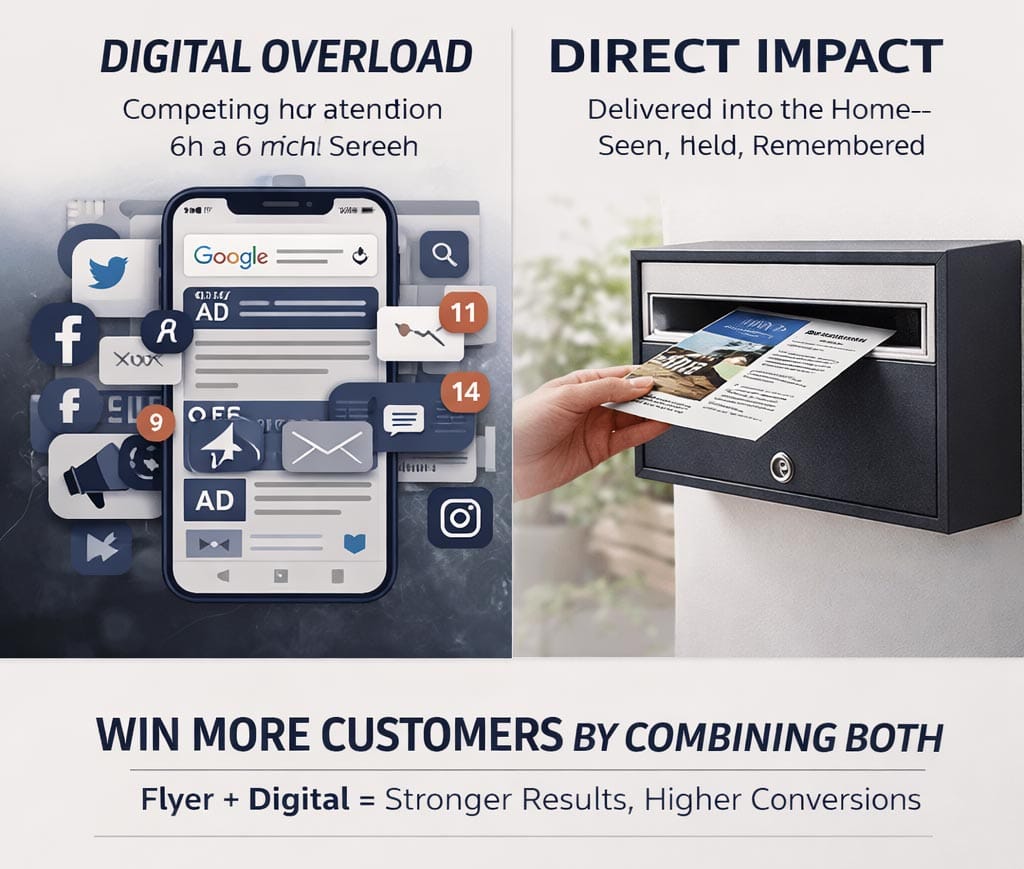
As digital advertising becomes more crowded, physical marketing stands out. Flyers are seen, touched, and remembered, while digital ads are often skipped or ignored.
A flyer stays in the home and is often viewed multiple times by different people.
The answer is simple — yes, when done correctly, it remains one of the most effective marketing channels available today.
Today, most digital advertising is viewed on a screen that’s only 6 inches wide — your mobile phone.
That small space is crowded with:
- Social media ads
- Google ads
- Emails
- Notifications
- Competing content
👉 Everything is fighting for attention in the same place.
As a result:
- Ads are quickly skipped
- Messages are forgotten
Attention spans are shorter than ever
👉 The Advantage of Physical Mail
Now compare that to a flyer delivered to a home.
- It’s not competing with 20 other ads on a screen
- It’s seen in a relaxed environment
- It can be revisited multiple times
- It often reaches multiple people in the household
This creates stronger attention and better recall.
👉 The Smart Approach: Combine Both
We’re not saying digital advertising doesn’t work — it absolutely does.
The best results come from combining both:
Flyer + Digital = Stronger Results
👉 Flyers strengthen your digital strategy.
Typical customer journey:
- Sees your flyer
- Searches your business online
- Recognises your brand
- Chooses you
Multi-channel marketing significantly improves conversions.
👉 When both channels work together:
- Brand trust increases
- Conversion rates improve
- Marketing becomes more effective
👉 Key Takeaway
You shouldn’t ignore digital marketing.
And you shouldn’t ignore physical marketing either.
The businesses getting the best results are using both together strategically.
Response rates vary depending on:
- Offer
- Design
- Targeted suburbs
However, flyer campaigns consistently deliver:
- Strong local visibility
- High brand recall
- Steady enquiry flow
👉 The key is consistent distribution, not one-off campaigns.
Yes — it is one of the most effective tools for local marketing.
You can:
- Target specific suburbs and streets
- Reach customers where they live
- Build local brand familiarity
👉 Familiarity builds trust — and trust drives enquiries.
Timing helps — but consistency matters more.
General guidelines:
- Early week → service businesses
- Weekends → retail & promotions
- Seasonal campaigns → best results
👉 Regular campaigns deliver stronger long-term results.
You can track performance using:
- Unique phone numbers
- Promo codes
- QR codes
- Landing pages
- Customer feedback
👉 This allows you to measure ROI and improve future campaigns.
Success depends on 5 key factors:
- Targeting the right area
- Strong design
- Compelling offer
- Consistent distribution
- Reliable delivery
👉 When combined, results become predictable and scalable.
Yes — and this is one of the strongest proofs it works.
Major brands like:
- Aldi
- Coles
- Woolworths
- Kmart
- Hungary jacks
- Dominos
…distribute millions of catalogues weekly because it delivers measurable ROI.
Costs depend on:
- Quantity
- Area density
- Flyer weight
However, flyer distribution remains one of the most cost-effective marketing channels available.
We deliver across all major regions of Greater Sydney, ensuring complete and accurate coverage
📍 Eastern Suburbs & CBD
| 📍 Western Sydney
| 📍 South West Sydney
|
📍 Inner West & Canada Bay Area
| 📍 Ryde & Northern District
| 📍 Upper North Shore & Hornsby Region
|
📍 Lower North Shore
| 📍 Northern Beaches
| 📍 Hills District & North West Growth Areas
|
📍 St George & Sutherland Shire
|
Yes.
All distributions are GPS tracked, recording:
- Delivery routes
- Streets covered
- Missed areas (if any)
Reports are provided after completion for full transparency and verification.
We follow client instructions.
- Most clients choose to avoid these
- If required, delivery can be adjusted
👉 We ensure compliance and flexibility based on your campaign.
Delivery time depends on:
- Quantity
- Area size
We provide:
- Start date
- Estimated completion timeline
👉 We can deliver over 1 million letterboxes per week.
Yes.
You receive:
- GPS tracking reports
- Coverage summary
- Delivery verification
👉 This ensures full accountability and campaign transparency.
A successful flyer distribution campaign requires more than simply printing flyers and delivering them to letterboxes. Australian businesses must ensure their marketing campaigns are conducted responsibly, ethically, and in accordance with environmental and local government requirements.
Poorly managed flyer campaigns can generate complaints, damage brand reputation, contribute to litter, and expose businesses to enforcement action by councils and environmental authorities.
The NSW Environment Protection Authority (EPA) identifies advertising and promotional material as a potential source of litter when it is discarded, left in inappropriate locations, or distributed irresponsibly. Businesses therefore have a responsibility to ensure their flyer distribution campaigns are properly managed from planning through to completion.
At APA Flyer Distribution, we have developed systems and procedures that help businesses achieve maximum campaign effectiveness while maintaining high environmental and operational standards. This guide outlines the compliance framework we recommend for all flyer distribution campaigns across Australia.
- Understand Australian Flyer Distribution Regulations
Before commencing any flyer distribution campaign, businesses should understand their responsibilities under relevant environmental legislation and local council regulations.
The NSW EPA recognises advertising material, including flyers, brochures, catalogues and promotional material, as a form of potential litter when it is left in public places or discarded improperly.
Businesses should ensure that:
- Flyers are delivered only to intended locations
- Distributors avoid leaving materials in public areas
- Excess flyers are collected and returned
- “No Junk Mail” and “No Advertising Material” notices are respected wherever practical
- Distribution activitiescomply withlocal council requirements
Some councils may have additional rules regarding flyer distribution in public spaces, pedestrian malls, transport interchanges, shopping precincts and community facilities.
Before launching a campaign, check with the relevant local authority regarding any permits or restrictions that may apply.
2. Verify Your Target Distribution Area
Accurate planning reduces waste and improves campaign performance.
Before printing flyers, businesses should:
- Identify the exact suburbs and streets to be covered
- Confirm the number of deliverable letterboxes
- Exclude unsuitable locations
- Identify apartment complexes requiring access arrangements
- Review any local distribution restrictions
By matching print quantities to actual deliverable addresses, businesses can reduce waste, lower costs, and minimise environmental impact.
Professional route planning also improves campaign accountability and reporting accuracy.
3. Train and Brief Your Distributors Properly
One of the biggest causes of distribution complaints is inadequate distributor training.
Every distributor should receive a written briefing that covers:
- Delivery boundaries
- Route maps
- Safety procedures
- Handling inaccessible properties
- Procedures for apartment complexes
- Respecting “No Junk Mail” notices
- Returning unused flyers
- Environmental responsibilities
Written instructions create accountability and provide evidence that distributors have been properly trained.
At APA Flyer Distribution, all distributors operate under documented procedures and campaign-specific instructions before commencing deliveries.
4. Implement GPS Tracking and Proof-of-Distribution
Modern flyer distribution should be fully trackable.
GPS tracking provides transparency, accountability and quality assurance.
Professional flyer campaigns should generate:
- GPS route maps
- Distribution timestamps
- Coverage reports
- Completion summaries
- Area verification records
- Distributor activity logs
GPS reporting enables businesses to verify campaign coverage and provides confidence that flyers were distributed within designated areas.
For clients investing significant marketing budgets, GPS reporting has become an essential part of professional flyer distribution.
Documentation | Purpose | Benefit |
GPS Route Maps | Confirm distribution areas | Transparency |
Time Stamps | Verify campaign activity | Accountability |
Coverage Reports | Measure completion | Performance tracking |
Completion Summaries | Compare planned vs actual | Campaign verification |
Distribution Logs | Record campaign activity | Audit trail |
5. Monitor Distributor Performance and Accountability
Quality control should never rely solely on trust.
Professional flyer distribution businesses implement performance monitoring systems that measure:
- Route completion
- GPS compliance
- Delivery accuracy
- Reporting quality
- Customer feedback
- Area coverage
Objective performance metrics encourage consistent standards and reduce the likelihood of missed areas or incomplete deliveries.
Businesses should also implement procedures for documenting inaccessible properties and managing surplus flyers responsibly.
6. Build a Structured Campaign Workflow
The most successful campaigns follow a documented process.
A typical workflow includes:
Planning
- Define campaign objectives
- Select target suburbs
- Calculate letterbox quantities
Preparation
- Print flyers
- Prepare route maps
- Assign distributors
Distribution
- GPS-tracked delivery
- Route monitoring
- Compliance checks
Reporting
- Generate coverage reports
- Review completion data
- Verify campaign outcomes
Analysis
- Evaluate response rates
- Identify improvement opportunities
- Optimise future campaigns
Structured workflows improve consistency, efficiency and accountability.
7. Navigate Schools, Community Centres and Restricted Locations
Distribution through schools, childcare centres, community organisations and other institutions may require separate approval processes.
Before distributing flyers through these channels, businesses should confirm:
- Approval requirements
- Content restrictions
- Flyer specifications
- Contact information requirements
- Sponsorship disclosures
- Community guidelines
Certain locations may prohibit commercial advertising altogether.
Obtaining approval before distribution helps avoid complaints and protects business relationships.
8. Conduct a Post-Campaign Compliance Audit
A compliance audit should be completed after every campaign.
The audit should verify:
- Distribution coverage
- GPS records
- Completion reports
- Distributor compliance
- Returned flyer quantities
- Customer reporting
- Complaint management
Maintaining campaign records helps businesses demonstrate accountability and continuously improve performance.
APA Flyer Distribution recommends retaining campaign records and reporting documentation for future reference and quality assurance purposes.
9. How APA Flyer Distribution Supports Compliant Flyer Distribution Across Australia
APA Flyer Distribution provides GPS-tracked flyer distribution services designed to deliver transparency, accountability and measurable results.
- Our systems include:
- GPS route tracking
- Coverage verification
- Completion reporting
- Distributor management
- Area planning
- Quality assurance procedures
- Environmental responsibility practices
By combining modern technology with experienced distribution teams, APA Flyer Distribution helps businesses achieve reliable campaign coverage while maintaining professional and environmentally responsible standards.
Whether you require local area distribution, regional campaigns or large-scale multi-location flyer delivery, our team can provide a tailored solution backed by comprehensive reporting and accountability.
Contact APA Flyer Distribution today for a customised quote and campaign strategy.
A flyer distribution compliance checklist is a structured framework that helps businesses manage planning, distribution, reporting and environmental responsibilities throughout a flyer campaign.
Flyer distribution may be subject to local council requirements and environmental regulations. Businesses should ensure materials are distributed responsibly and do not contribute to litter.
GPS tracking provides transparency, confirms coverage areas and creates an audit trail that helps verify campaign completion.
Yes. Respecting resident preferences is considered best practice and helps reduce complaints and negative brand perception.
Unused flyers should be collected, documented and either reused for future campaigns or recycled appropriately. They should never be discarded in public places.
Businesses can reduce waste by accurately calculating print quantities, targeting distribution areas effectively, using recyclable materials and implementing proper campaign reporting systems.